 NCDD members, the National Civic League, are preparing to launch the Healthy Democracy Ecosystem Map and are seeking assistance in ensuring data completeness and accuracy. Their mission is to identify, categorize, and quantify existing organizations, networks, and funders who work to promote and protect healthy democracy in America, and to create a compelling, interactive resource that educates and empowers users. The map aims to offer a comprehensive view of organizations promoting healthy democracy in America, covering various areas like civic education, voter engagement, and civic technology. Read the blog post below, fill out the form, and learn more here.
0 Comments
Many suburban developments built in the last century are now facing urgent repair needs. NCDD member, Miles Fidelman, an engineer with extensive experience, is addressing these challenges in his community of Nagog Woods, a 50-year-old condominium complex. He highlights the necessity of comprehensive measures and collaboration to avoid skyrocketing costs and catastrophic failures. Fidelman invites the community to follow his journey of organizing and financing major renovations, aiming to create sustainable, affordable, and well-maintained neighborhoods. Through this initiative, he seeks to provide a blueprint for other communities to follow. Thanks to Miles Fidelman for sharing this announcement with the NCDD network! Learn more in the blog post below and read the article here.
NIFI's "Everyone's In" Initiative for Respectful Political Dialogue - Tools Plus Upcoming Workshops6/20/2024  "Everyone’s In" (EI) is a new initiative from NCDD friends, the National Issues Forums Institute (NIFI), designed to facilitate respectful and inclusive discussions on controversial political issues. It aims to promote understanding and learning, with a focus on elections and voting. The program employs updated forum formats and materials for both online and in-person settings, incorporating informal polls, background information, and thoughtful dialogue to ensure inclusive participation and engagement on political subjects. Find resources and upcoming training opportunities in August to support using the EI guides. Read more in the blog post below and learn more here.
 NCDD member org, Essential Partners, announced their new publication, Guide to Dialogues About Israel-Palestine, to actively equip those interested in facilitating dialogues in various settings. This guide emphasizes the importance of respecting diverse perspectives without compromising identities or advocating extreme viewpoints, recommends skilled facilitation for highly polarized situations, and extends support to both trained and untrained facilitators. Its ultimate goal is to cultivate open, hopeful, and caring dialogue spaces amidst complexity and differences. Learn more below and on EP's site here.
 The Restorative Justice Map Project, developed by NACRJ in collaboration with NCORJ and the Center for Restorative Justice, celebrates its one-year anniversary in May. With over 200 submissions already, the project serves as a valuable hub for individuals seeking restorative justice practitioners and programs nationwide. As the anniversary approaches, submissions are encouraged to expand the map's reach and effectiveness in connecting professionals and communities interested in restorative justice. Learn more in the post below and on NACRJ's site here.
 With the highly anticipated 2024 U.S. Presidential Election upcoming, make sure you utilize this suite of vital resources designed to tackle polarization head-on, thanks to NCDD Member Organization, Essential Partners. From bridging partisan divides to fostering resilience in discourse, these resources offer practical tools for schools, institutions, and individuals to engage in healthier, more authentic conversations. Explore guides for navigating tough discussions, innovative classroom curricula, and empowering independent learning modules, all aimed at forging stronger, more inclusive democracy. Learn more in the post below and on EP's site here.
 The 2024 Digital Participation Tool Ratings, launched by People Powered, offer expert evaluations of leading digital participation tools to aid democracy practitioners worldwide in finding the most suitable options for their needs. This latest edition features new platforms, an enhanced methodology, and improved accessibility through Airtable. Developed in collaboration with six global participation technology experts and incorporating feedback from diverse users and developers, the ratings strive to foster accessibility, inclusivity, and security within digital participation platforms. Learn more below.
Have you heard the news?! NCDD is thrilled to announce the launch of our NCDD Working Groups and Exchanges - and you're invited to join! 2024 is already looking to be an important year and there is a lot of energy for dialogue, deliberation, and engagement work. NCDD is uniquely positioned to bring together our collective wisdom, experiences, and passion for change to reflect and collaborate together. Coming out of the 2023 conference, NCDD is excited to be harnessing the collective energy and capacity of this coalition through the formation of working groups that align with key priority areas for the organization, as well as exchanges that will allow the membership to deepen connections. These groups are intended to provide our members with focused opportunities to connect, collaborate, build capacity, and invest in our shared coalition. Current NCDD Working Groups A number of potential focus areas were suggested at the 2023 conference. The NCDD staff and board have determined that these following groups are best aligned with current organization priorities and can also play a key role in building and sustaining NCDD as an inclusive coalition and a thriving organization.
Joining a Working Group Working groups open to all, please fill out this form. While you are not required to be an NCDD member, your support helps make these groups possible - become one today! Current NCDD Exchanges
Joining the Exchange Express your interest in this exchange by filling out this brief form. The form asks for ways you would like to communicate around the exchange, as well as opportunities to present and lead the group. Want to Start a New Exchange? NCDD is excited to support additional exchanges focused on bringing our network together around specific sectors, areas of interest, etc. If you would like to discuss starting a new exchange, reach out to NCDD’s Executive Director, Courtney Breese, at [email protected]. Additional Questions? Please contact NCDD’s Communications Coordinator, Keiva Hummel, at [email protected].  SHARE YOUR INPUT! The National Issues Forums Institute, a NCDD member organization, is seeking feedback on their issues guide materials. NIFI has a wide range of issue guides and these materials have been important tools in the dialogue and deliberation field for over two decades. Learn more in the post below, including the link to the survey.
Happy Facilitation Week! In honor of this week recognizing the importance of facilitation practice (read more about it a facilitationweek.org), our friend Jason Diceman at Feedback Frames is offering our network an amazing deal on this tool for in person meetings! Learn more below. 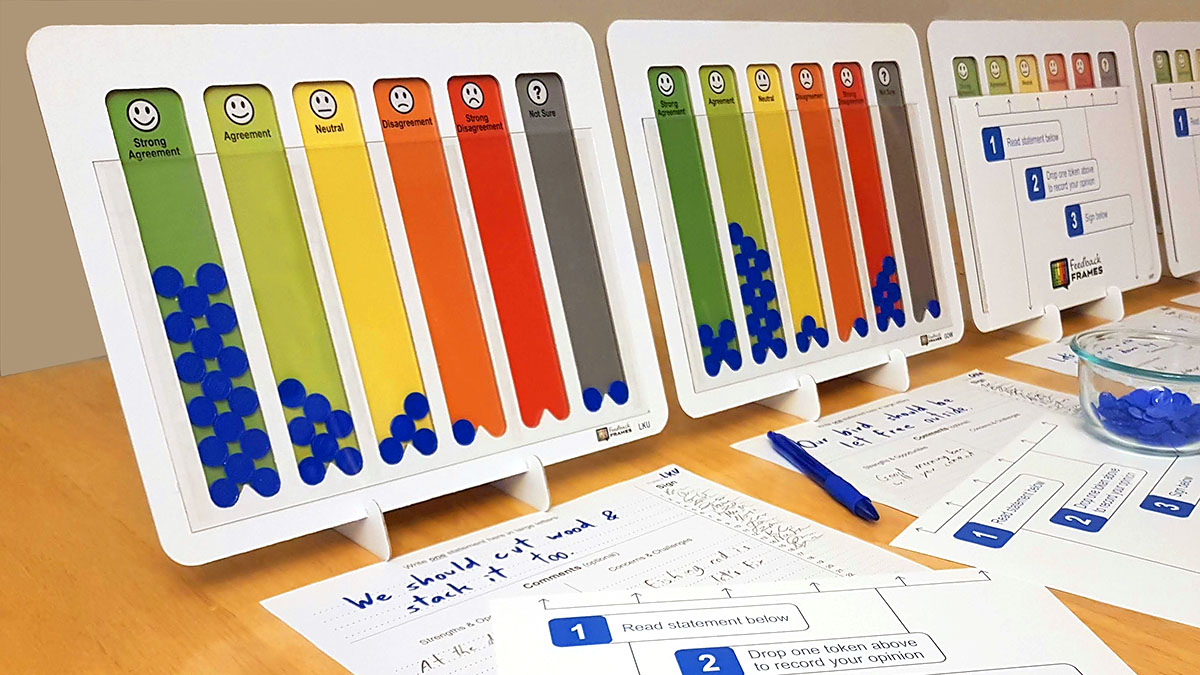 To help support the important facilitation work of NCDD members, Feedback Frames is offering a 40% discount this week only.
|
Categories
All
|
 RSS Feed
Follow Us
ABOUT NCDD
NCDD is a community and coalition of individuals and organizations who bring people together to discuss, decide and collaborate on today's toughest issues.
© The National Coalition For Dialogue And Deliberation, Inc. All rights reserved.
© The National Coalition For Dialogue And Deliberation, Inc. All rights reserved.